

Axiad commissioned a survey of 312 senior security and IT leaders at U.S. enterprises and uncovered a consistent gap between perceived identity risk visibility and the ability to act on it when it matters most.


Axiad surveyed 312 senior security and IT leaders at US enterprises to understand how wellorganizations can actually see, quantify, and act on identity risk. The results reveal a consistent andconcerning pattern: confidence in identity risk posture frequently outpaces the operational realitybehind it.
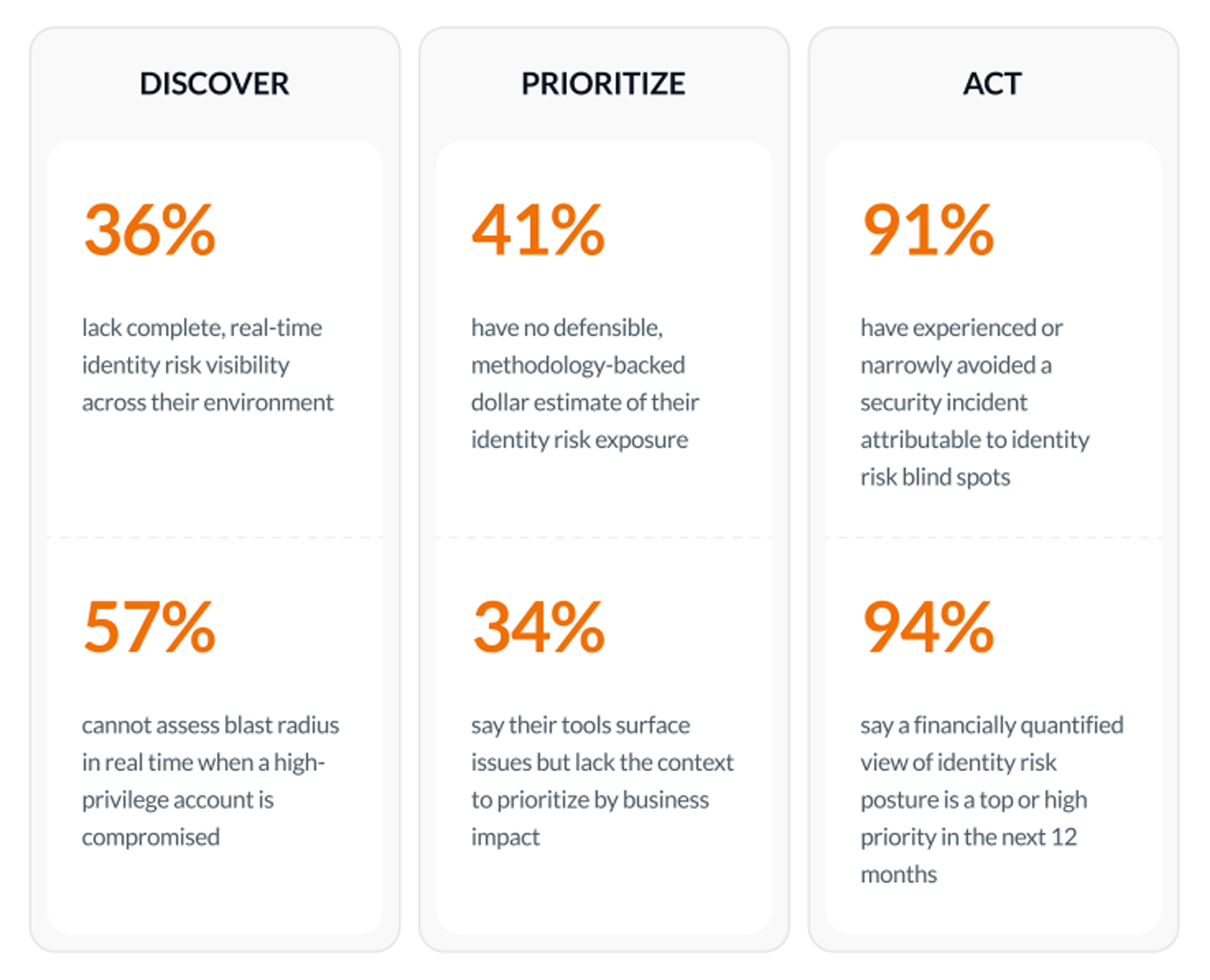
Nearly two-thirds of respondents say they have complete, real-time identity risk visibility. Yet morethan half cannot assess the blast radius of a compromised account within minutes. Almost a third lack adefensible, methodology-backed dollar estimate of their exposure. And more than a third admit theirtools surface issues but cannot tell them what to fix first.
The gap is not between organizations that care about identity risk and those that don't. It is betweenthose who believe they have the situation covered and those who actually do. That gap is wherebreaches happen, where remediation resources get misallocated, and where the board conversationfalls apart.
"As AI accelerates the pace of vulnerability discovery, the ability to prioritize andact on identity risk with speed and precision is becoming a competitive andfinancial necessity. The organizations that close this gap will be those that candiscover the full scope of their identity risk, prioritize what matters most infinancial and operational terms, and act with speed and confidence. That is thecapability this research points toward — and the gap it quantifies.”
When asked directly, 63.5% of respondents say they have a complete, real-time picture of identity riskacross their environment. That number sounds reassuring. But a second question tells a harder story.Asked how quickly they could assess the full blast radius of a compromised account with broad accessprivileges, fewer than half (42.6%) said they could do it within minutes with real-time access pathvisibility. The majority require hours or longer. A small percentage say they couldn't do it reliably at all.
"The gap between perceived visibility and operational readiness is the real blindspot. More than one in three organizations that believe they have completeidentity risk visibility cannot actually respond to a breach scenario in real time.”
This divergence is the core story of this report. Believing you can see your identity risk surface is notthe same as being able to act on it. When an incident actually unfolds, the organizations that need hoursor days to understand the scope of exposure are the ones that take the hardest hits.
This is not a theoretical risk. The overwhelming majority of security leaders surveyed have alreadyencountered a concrete consequence of incomplete identity risk visibility — whether that was a breachwith measurable financial or operational impact, an incident that required significant unplannedresources to remediate, or a situation where root cause could not be definitively attributed.
Only 9% reported no incident of this kind to their knowledge.
The 38% who experienced an incident with measurable financial or operational impact is the numberthat translates directly into board-level risk language. Identity risk blind spots are not a future problemto solve before something bad happens. For more than one in three organizations in this sample, the billhas already come due.
Effective security investment requires the ability to quantify risk in financial terms. Without adefensible dollar estimate of identity risk exposure, security leaders cannot make a compelling case tothe CFO, cannot prioritize remediation against competing budget demands, and cannot demonstrate tothe board that they understand the scope of the problem.
But there is a tension worth noting. Even among the 59% who claim a defensible estimate, the barrierdata reveals something more complicated: 'lack of financial context to justify remediation investment'ranks as the third-largest obstacle to acting on identity risk gaps. If organizations truly had amethodology-backed financial picture of their exposure, this barrier should be less common.
The most likely explanation: the 'defensible estimate' many claim is neither as precise nor as actionableas the question implies. Informal dollar figures get described as methodology-backed. The rigor behindthe number varies widely. And without a common framework like FAIR-based annualized loss exposure,the estimate often cannot survive scrutiny in a board or CFO conversation.
“The inability to quantify or communicate identity risk to leadership and theboard was cited by 22% of respondents as the single greatest risk theirorganization faces from incomplete identity visibility — second only tocredential-based attacks going undetected.”
The Mythos insight that informed this survey — that the security bottleneck has shifted from detectionto decision — is borne out in the data. When respondents were asked what prevents their organizationfrom acting on identity risk gaps once identified, the leading barriers were not about finding theproblems. They were about knowing what to do with them.
The top two barriers — managing credentials across heterogeneous environments and fragmentedtools with no unified view — describe the same underlying problem: organizations have accumulatedauthentication sprawl with no orchestration layer to make sense of it. These are Discover barriers:without a unified view, you cannot know what you are dealing with. The third and sixth barriers — lackof financial context and too many findings with no clear prioritization signal — are Prioritize barriers:the data exists but cannot be translated into a defensible decision. Together they explain whyorganizations that detect identity risk still struggle to act on it.
Meanwhile, 34% of respondents say their tools surface issues but lack the context needed to prioritizeby business impact. Their technology generates findings. It cannot tell them which ones matter most.
And despite 66% expressing high confidence in their prioritization framework, 41% are still prioritizingbased on compliance requirements rather than risk, meaning their decisions are driven by externalmandates rather than defensible internal judgment about what exposes the organization most.
AI-powered vulnerability discovery is changing the threat landscape in a specific and predictable way:more findings, faster. The volume of potential identity risks surfacing in enterprise environments isgrowing at a rate no human security team can keep pace with through manual prioritization.
Security leaders know this. 85% express at least some level of concern about AI-accelerated threatsoutpacing their organization's ability to prioritize and respond. More than half are very or extremelyconcerned.
The organizations most vulnerable in an AI-accelerated threat environment are not those that lackdetection capability. They are those that cannot decide fast and defensibly what to fix first. The volumeof findings is increasing. Without a decision layer that can contextualize exposure in financial andoperational terms and surface the highest-priority gaps, security teams will be buried in noise.
The demand signal in this data is as clear as the problem it reflects. Security leaders are not waiting forsomeone to tell them this matters. They already know. The question is whether they have the tools todo it.
51% say it is a top priority, actively budgeted and in progress. Another 43% call it a high priority,planned but not yet fully resourced. Less than 1% call it low priority.
“The organizations in this survey are not debating whether to build a morecomplete, financially quantified identity risk posture. They are figuring out how.The gap between intent and execution is where the opportunity lies.”
The findings in this report describe three interconnected gaps that prevent organizations frommanaging identity risk effectively. Together they define the capability organizations need to close theblind spot.
Axiad commissioned this survey through Centiment, a B2B panel provider, fielded in May 2026. Thesurvey reached 312 senior security and IT leaders at US enterprises with 500 or more employees.Respondents held titles including CISO, CIO, VP of Security, Director of Security, and VP/Director ofIdentity & Access Management.
The sample was designed to represent the commercial enterprise market, with technology intentionallycapped at approximately 20% of the sample to prevent vertical skew. Industry distribution in the finalsample: Manufacturing/Industrial (23%), Technology/Software (18%), Financial Services/Banking (14%),Healthcare/Life Sciences (14%), Professional Services (12%), Retail/Consumer (11%), Government/Public Sector (4%), Energy/Utilities (3%), Insurance (1%), Other (2%).
Company size distribution: 1,000-4,999 employees (48%), 5,000-14,999 (24%), 500-999 (17%),15,000+ (11%). All respondents confirmed personal involvement in evaluating, selecting, or overseeingidentity security and authentication solutions at their organizations. A data quality check confirmed100% of respondents correctly identified the attention verification item.


FedRAMP Moderate Authorized (Conductor). Frost and Sullivan Customer Value Leader. Gartner Market Guide Recognized. ISO/IEC 27001. SOC 2 Type II.
Copyright Axiad 2026. All rights reserved.