


.svg)
%201.svg)

.svg)
.svg)

.svg)
.svg)

of security leaders have already experienced or narrowly avoided anincident caused by identity-risk blind spots.
Source: Axiad survey of 312 senior security and IT leaders at US enterprises, May 2026.
Nearly two in three security leaders say they have a complete, real-time picture of their identity risk. More than half can't tell you the blast radius of a compromised account when it happens. That gap — between the confidence and the reality — is where breaches live.
Your tools can see identities by the thousand: people, service accounts, API keys, certificates, and now AI agents that outnumber your humans many times over. What no other tool tells you is which of those risks actually matters, what it would cost, and what to do about it. Until now. That's the decision layer — and it's the gap Axiad Mesh fills.
.svg)


Your IAM, IGA, and PAM tools each see a slice. None see identity risks across on-prem, SaaS, and cloud at once. So risk that spans systems never gets owned end to end.
Service accounts, API keys, certificates, and AI agents outnumber your people — and no one is watching most of them. An identity strategy that only covers humans protects a fraction of the environment.
Discovery tools surface findings by the hundred.
of organizations say their tools flag issues but can't tell them what to fix first. When everything is flagged, the real risks drown.
Source: Axiad survey, n=312, May 2026.
Identity risk stays invisible to the business.
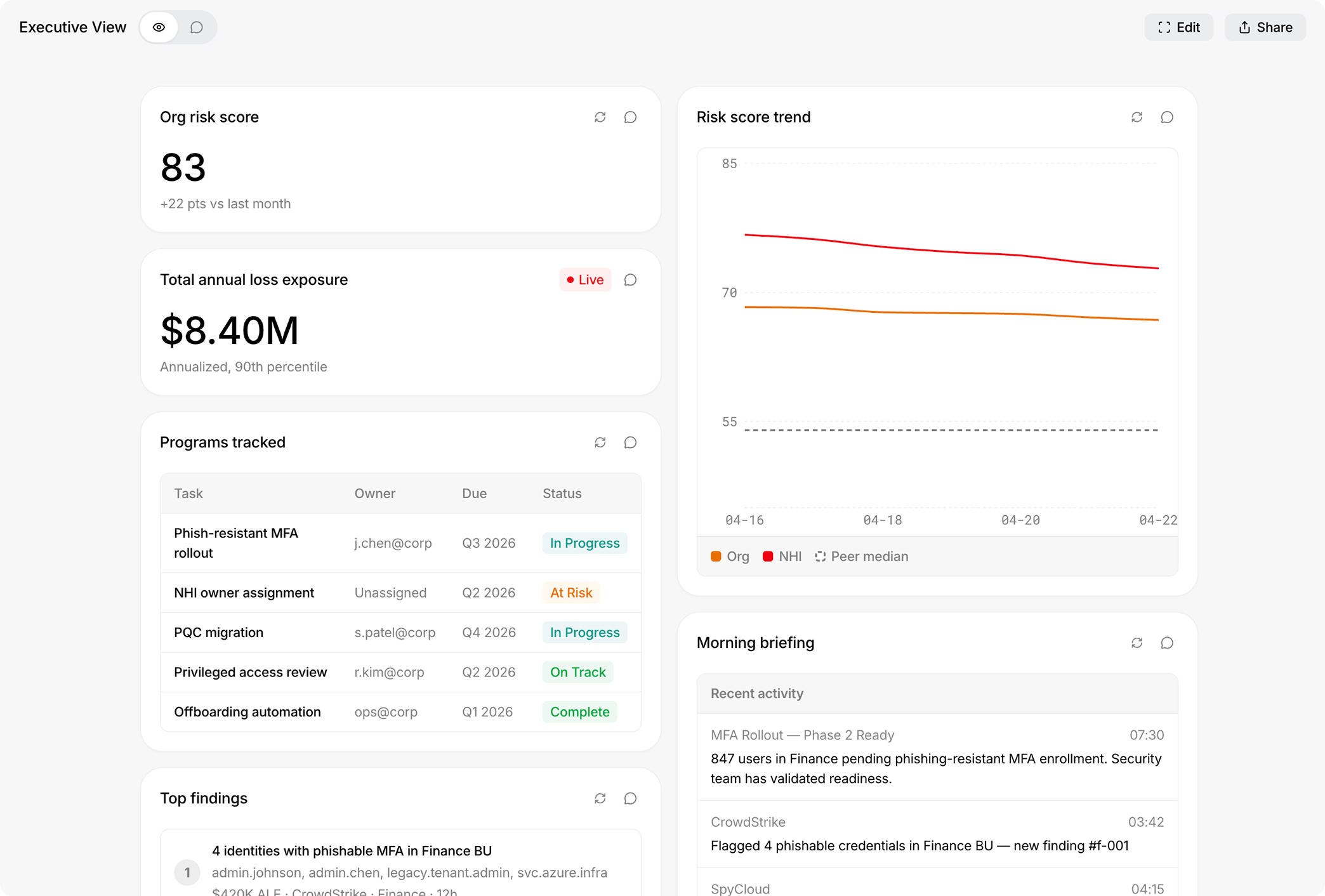
of enterprises have no methodology-backed dollar estimate of their identity risk. Without a dollar estimate, it rarely reaches budget discussions.
Source: Axiad survey, n=312, May 2026.
.svg)
From every identity to the right fix – in four moves

.svg)
See every identity
Understand identity access
.svg)
Rank by dollar impact
Fix it in the tools you already use
Mesh discovers and continuously watches every identity across your environment — human and non-human — and connects the accounts, credentials, and entitlements that belong to each one, even when 18 systems spell the same identity 18 different ways.

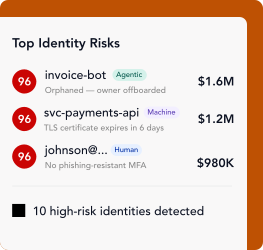
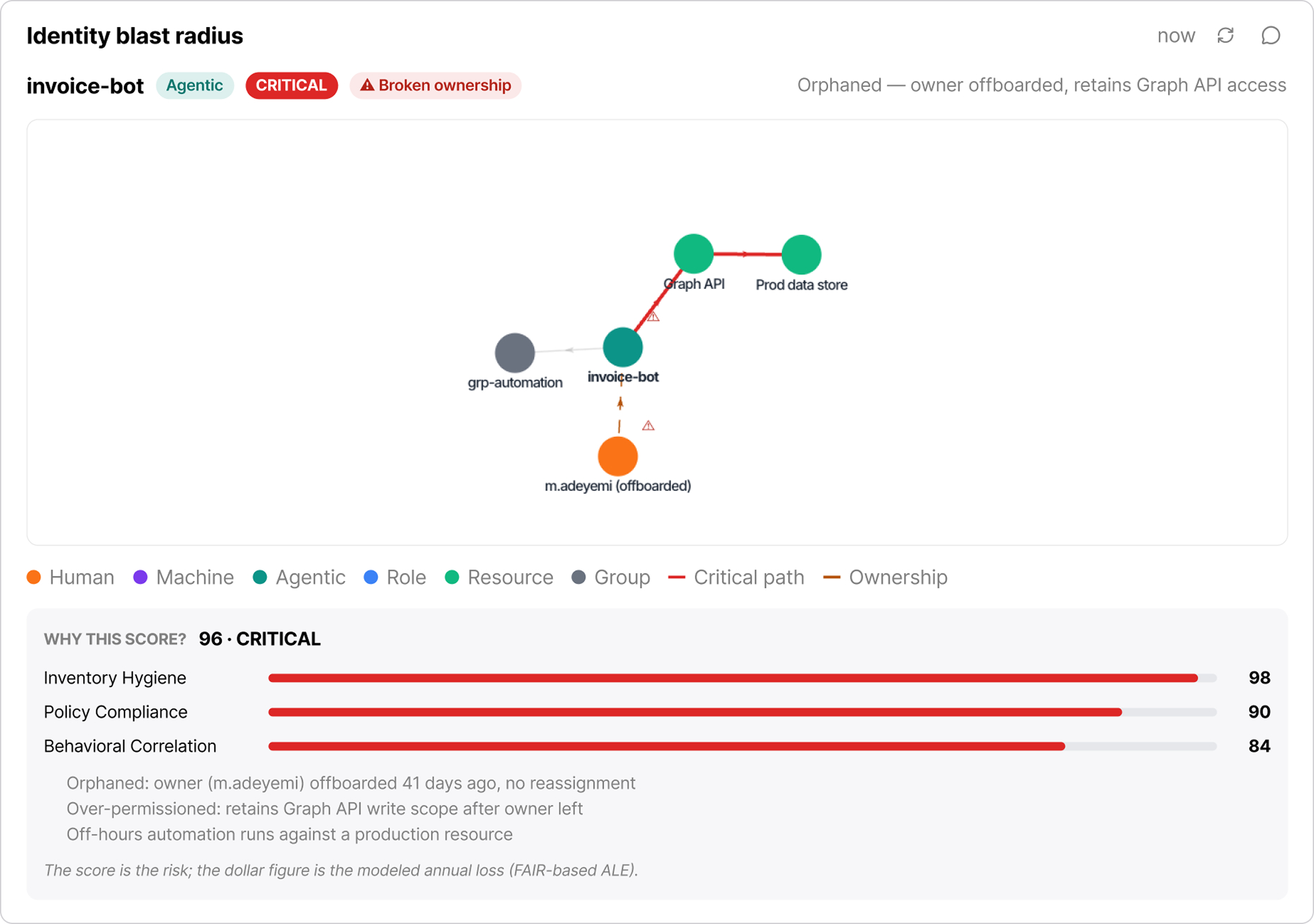
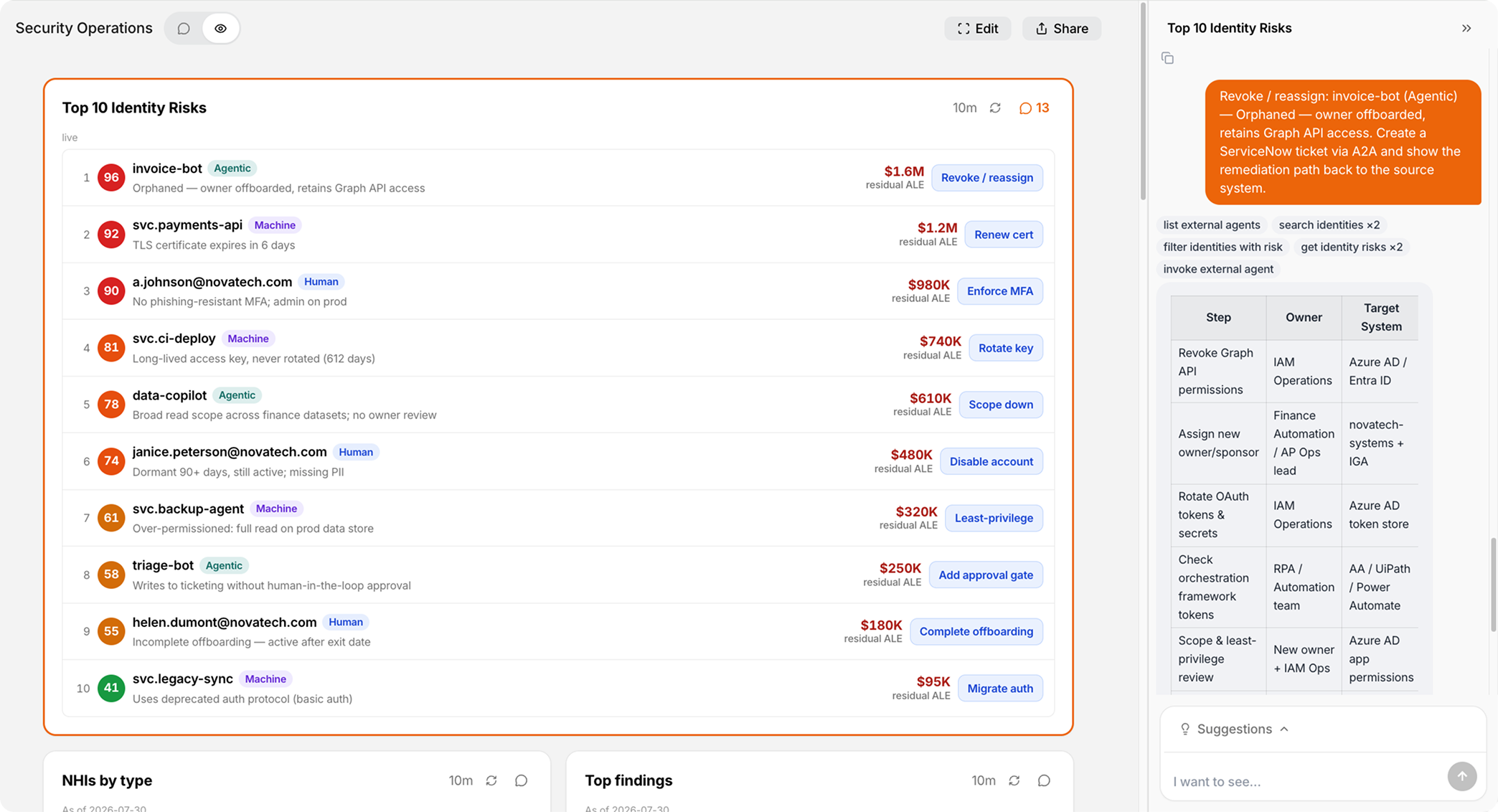
A simple list of identities doesn’t show risk. Mesh builds a comprehensive record for each one — what it can access, what it connects to, and the blast radius if it were compromised. Context is what turns a finding into a decision.
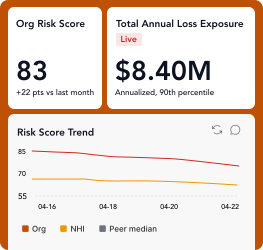
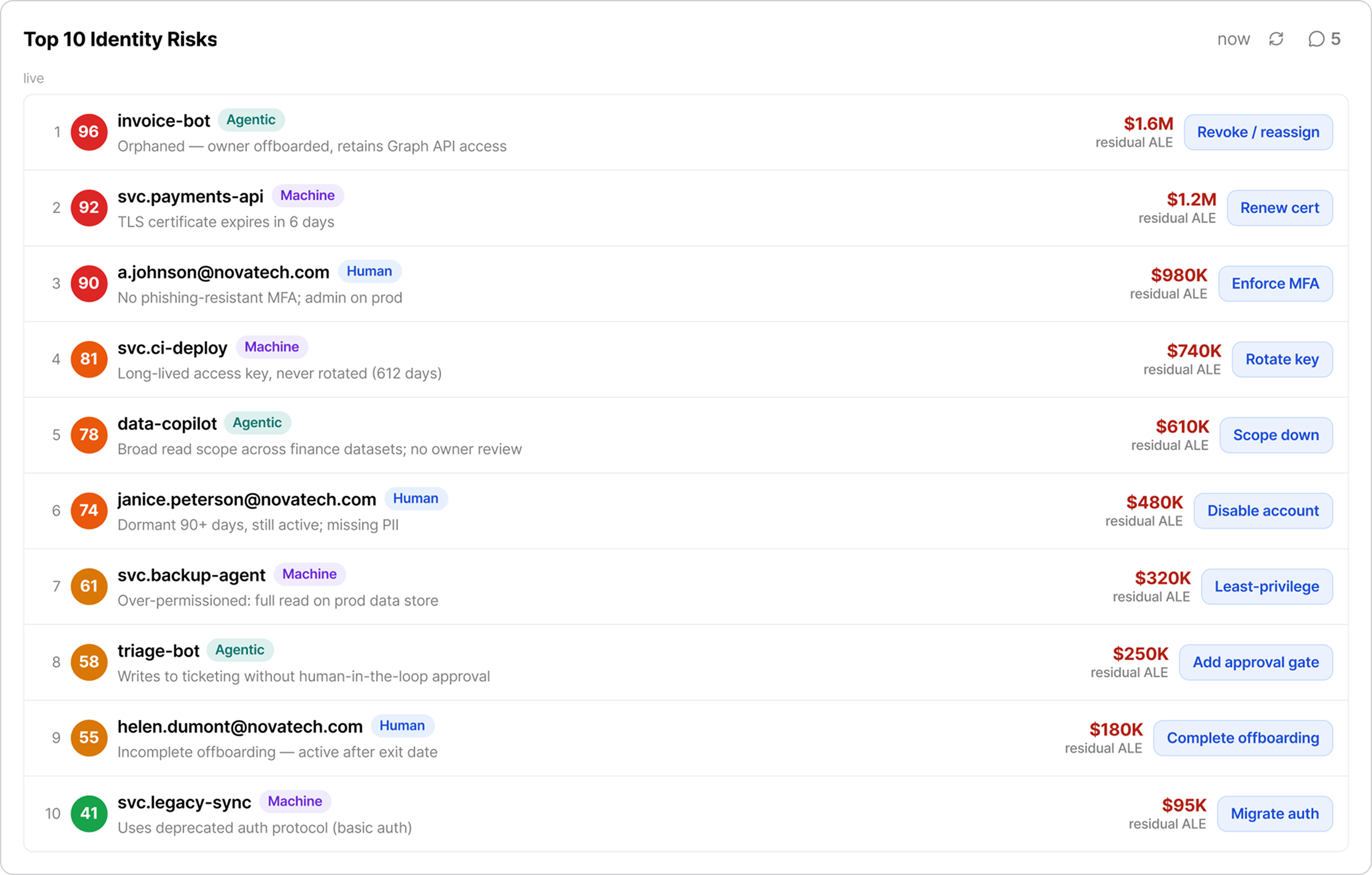
When everything is urgent, nothing is. Mesh ranks every risk bywhat it would actually cost the business — using the same annual loss exposure methodologies your board and cyber-insurance conversations already speak. It tells you which risks matter, and why.
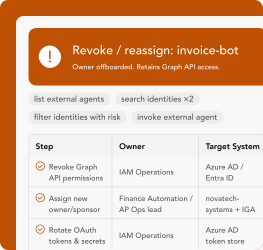
Findings don't reduce risk; fixes do. Mesh routes the right fix tothe right owner and tracks it to closed — inside the platforms your teams already run.
.svg)

Know what breaks before quantum does. Post-quantum readiness is an identity problem before it's a cryptography problem — you can't migrate what you can't see. Mesh discovers every cryptographic identity across your environment (certificates, keys, service accounts), flags the ones that can't survive the transition, and tracks your migration against the mandates and deadlines already on the calendar. Backed by the team that has run PKI at the highest assurance levels for15+years so PQC isn't a pivot for Axiad, it'sthe next chapter.
.svg)
Bring your machine and AI-agent identities into the light. Machines and AI agents outnumber your people many times over, and most carry credentials no one audited and no clear owner. Mesh discovers every non-human identity — service accounts, API keys, and autonomous AI agents — and quantifies the financial risk each one carries, the same dollar lens it applies to your people. The identities acting fastest in your environment stop being the ones you see least.
.png)
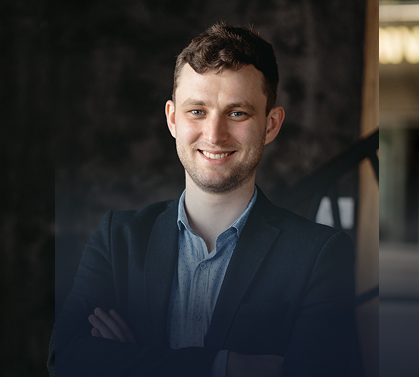
Top 10 US Financial Institution


Mesh becomes valuable when it helps identity teams prioritize, operationalize, and act — not simply generate more findings.
We spent six months evaluating vendors and came up empty. Everyone else claimed to do everything. Axiad told us exactly what it does today — and then delivered it.
say a financially quantified view of identity risk is a top or high priority inthe next 12 months
are concerned AI-accelerated threats will outpace their ability to respond
have already had, or narrowly avoided, an identity-risk incident
Source: Axiad survey, n=312, May 2026.
.svg)
.png)
Almost every enterprise has a fast-growing, poorly defended attack surface: its identity ecosystem. This guide shows how security teams are identifying, quantifying, and fortifying the identities their business runs on.
.svg)

An independent research note from Software Analysts Cyber Research maps the gaps between posture management (ISPM) and threat detection (ITDR) — and where applied risk quantification closes them

.svg)
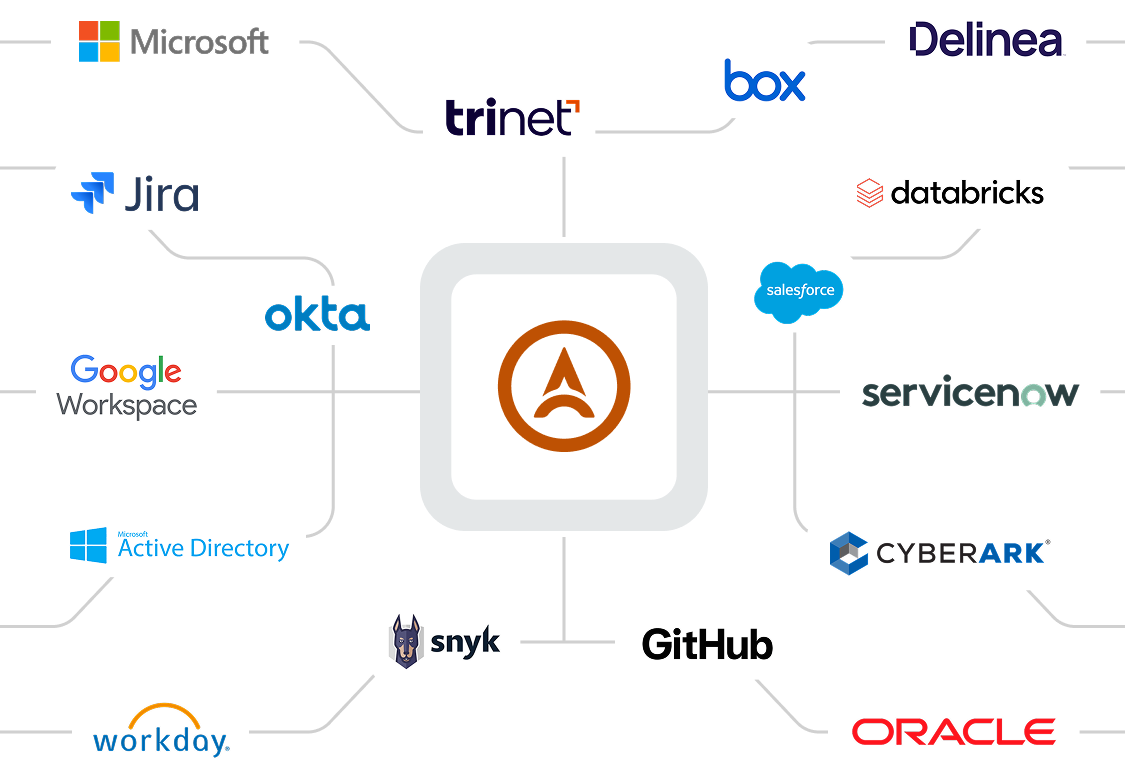
No. Mesh connects to the identity providers, IGA, and PAM tools you already run and assesses risk across them. It's the fabric on top that tells you what to fix first — not another system to rip in.
That's the point. Mesh discovers the accounts, service credentials, and machine identities your current tools miss, scores each by financial impact, and routes the ones that matter into your existing remediation workflow — so a surprise becomes a prioritized, owned task, not a fire drill.
Because Mesh reads from your existing stack instead of deploying agents everywhere, most teams see a scored, dollar-quantified picture of their identity risk in weeks, not quarters.
Mesh treats AI agents as first-class identities — discovering them, scoring their risk, and measuring their blast radius the same way it does humans and service accounts. Agents act autonomously with credentials no one audited; Mesh makes them visible and rankable alongside everything else.
Axiad has fifteen-plus years securing identity for federal, defense, and highly regulated organizations — Axiad Conductor is FedRAMP Moderate authorized. Axiad Mesh is a commercial, workforce-focused platform and is not offered under FedRAMP. If your program needs FedRAMP-authorized credential management, that's Conductor; Mesh is built for commercial and enterprise identity-risk visibility.
.svg)
.svg)
FedRAMP Moderate Authorized (Conductor). Frost and Sullivan Customer Value Leader. Gartner Market Guide Recognized. ISO/IEC 27001. SOC 2 Type II.
Copyright Axiad 2026. All rights reserved.


.svg)






.svg)
.svg)