
Certificate lifespans are already down to 200 days and fall to 47 by 2029. Axiad CLM finds every certificate across every certificate authority, ties each one to an owner, and rotates it automatically before it expires.



Certificate lifecycle management used to be a once-a-year chore. The CA/Browser Forum changed that for every publicly trusted TLS certificate.



Discovery tools and spreadsheets cover the certificates someone remembered to register. Outages come from the rest: the test certificate promoted to production, the appliance no one owns, the certificate issued straight to a phone.
Eight renewals a year, per certificate, across thousands of certificates. Manual tickets and one-off scripts held up at annual renewal. At this cadence they turn into a standing queue of outages waiting for a date.
Public CAs, a Microsoft CA, a cloud provider's CA, a vendor's private CA. Each has its own tools and its own view, so no one sees the whole estate, and policy depends on which console a certificate came from.
NIST has finalized its first post-quantum standards, and federal and industry mandates now come with dates. You can't migrate cryptography you can't find. Teams that can't list their certificates today can't plan a migration that touches every one of them.



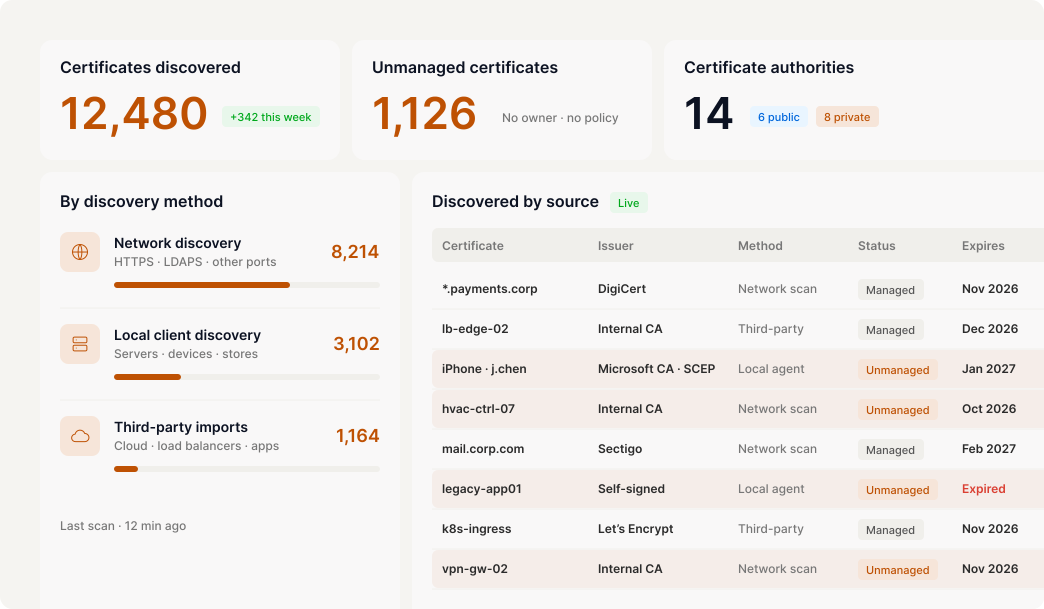
Find every certificate, from every authority
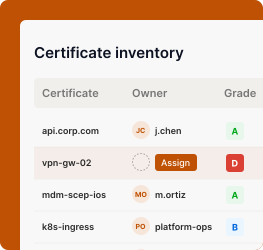
Tie each certificate to an endpoint and a person
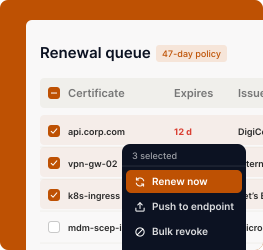
Issue, renew, and revoke on policy
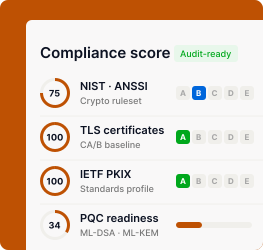
Show coverage, rotation, and progress
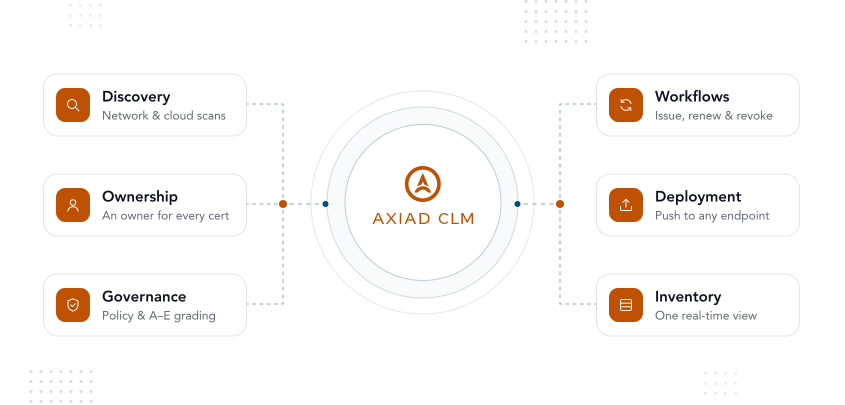
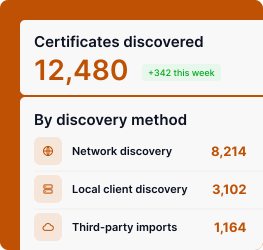
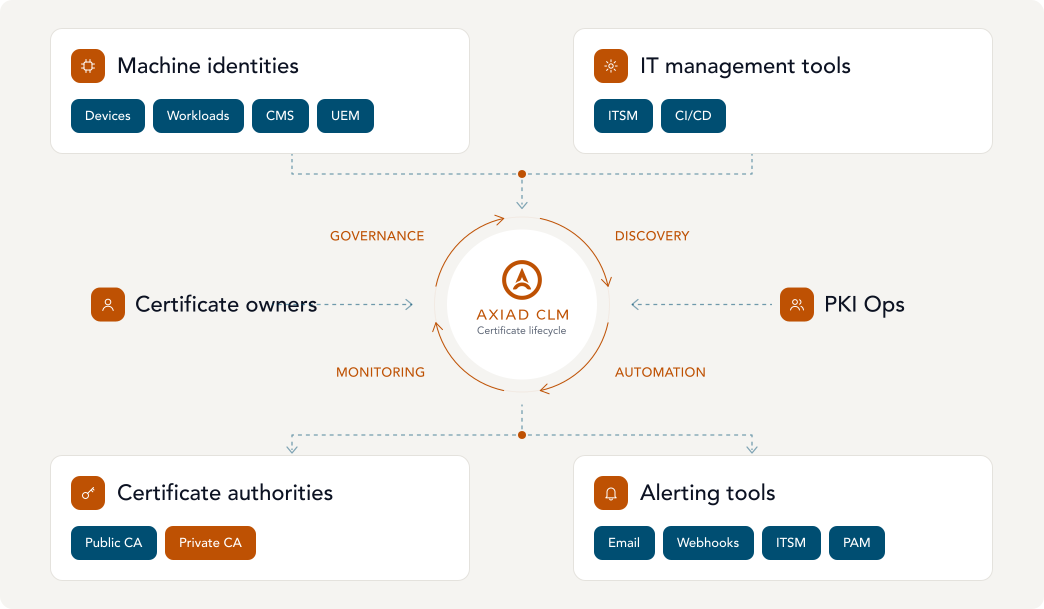
Axiad CLM discovers every certificate across your environment no matter which authority issued it, including the unmanaged and forgotten ones. It reaches servers, devices, and appliances, plus certificates issued directly to users, such as SCEP certificates on mobile phones.

An inventory without owners is a list of future outages. CLM ties each certificate to the endpoint it secures and the person accountable for it, so a renewal never waits on someone figuring out whose problem it is.
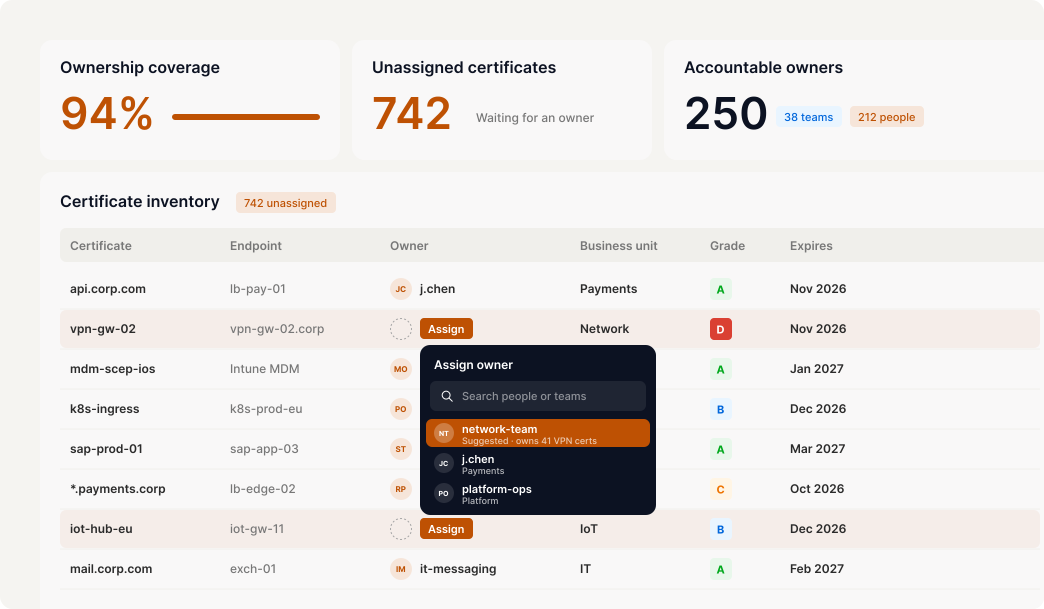
Set policy once and CLM enforces it everywhere. It manages issuance, renewal, and revocation and automates rotation at the 47-day cadence, so renewals happen on schedule instead of on someone's calendar.
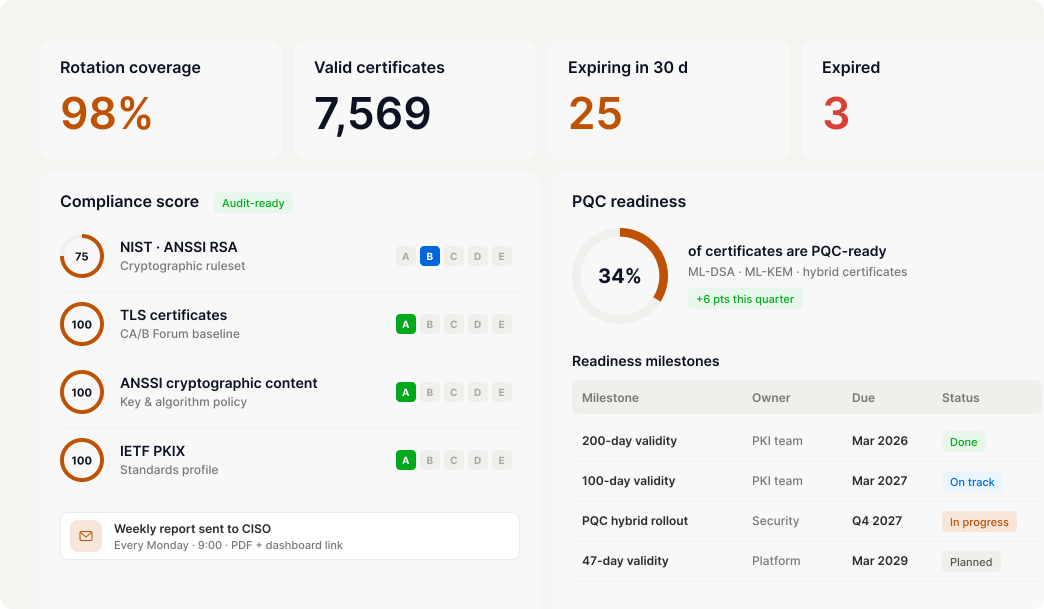
Every certificate rolls up into a single view of coverage and rotation, so you can answer an auditor, or your CISO, without a manual scramble. The same view tracks your post-quantum readiness against the deadlines already on the calendar.


Put every certificate on automated renewal before the 100-day step. CLM moves your estate off tickets and scripts now, while the cadence still leaves room to fix what discovery turns up.
Most CLM tools stop at the certificate. Axiad CLM is part of a platform that also decides which certificate and key risks matter most. Axiad Mesh ranks them by dependency and blast radius, and CLM executes the fix. Axiad Conductor does the same for workforce credentials.

Ranks which certificate and key risks matter most, by dependency and blast radius.

Executes the fix on certificates and non-human identity: discovery, renewal, rotation and revocation.

Does the same for workforce credentials, from issuance to phishing-resistant MFA.


Yes. Axiad CLM is CA-agnostic. It discovers and manages certificates regardless of which authority issued them, public or private, so you don't have to standardize on one CA to get one view.
No. Many teams start by discovering what their current tools miss, then consolidate when a renewal comes up.
Agentless wherever possible. A lightweight agent is used only where a system requires one, such as some servers and appliances.
The CA/Browser Forum schedule cuts maximum validity for publicly trusted TLS certificates to 200 days as of March 15, 2026, 100 days on March 15, 2027, and 47 days on March 15, 2029. The best time to automate is before the 100-day step, while there's still room to fix what discovery turns up.
Axiad Conductor is FedRAMP Moderate Authorized, and Axiad CLM is on a credible path to FedRAMP authorization. If your program needs FedRAMP today, talk to us about where CLM stands and what's available now.


FedRAMP Moderate Authorized (Conductor). Frost and Sullivan Customer Value Leader. Gartner Market Guide Recognized. ISO/IEC 27001. SOC 2 Type II.
Copyright Axiad 2026. All rights reserved.