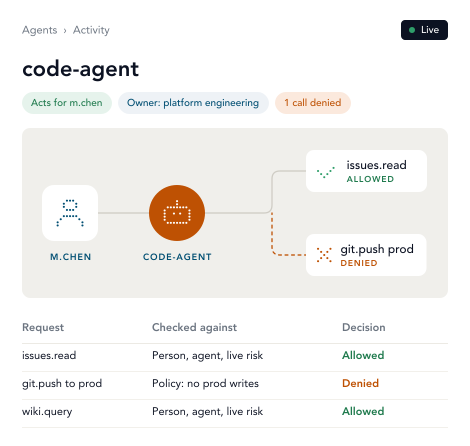
AI agents moved from pilots into your employees' everyday tools faster than security could onboard them. Mesh agentic security finds them, ties each one to the person it acts for, and shows what each one actually did. Through the gateway, it checks every agent call against the person, the agent, and live risk, and denies it unless policy allows it.


Discovery tools and spreadsheets cover the certificates someone remembered to register. Outages come from the rest: the test certificate promoted to production, the appliance no one owns, the certificate issued straight to a phone.
Eight renewals a year, per certificate, across thousands of certificates. Manual tickets and one-off scripts held up at annual renewal. At this cadence they turn into a standing queue of outages waiting for a date.
Public CAs, a Microsoft CA, a cloud provider's CA, a vendor's private CA. Each has its own tools and its own view, so no one sees the whole estate, and policy depends on which console a certificate came from.
of security leaders worry AI is outpacing their ability to respond.
Axiad survey, n=312, May 2026
"The identity may be valid. The access may be legitimate. The action may still be wrong."
David Canellos, CEO, Axiad


Discovery tools and spreadsheets cover the certificates someone remembered to register. Outages come from the rest: the test certificate promoted to production, the appliance no one owns, the certificate issued straight to a phone.
Eight renewals a year, per certificate, across thousands of certificates. Manual tickets and one-off scripts held up at annual renewal. At this cadence they turn into a standing queue of outages waiting for a date.
Public CAs, a Microsoft CA, a cloud provider's CA, a vendor's private CA. Each has its own tools and its own view, so no one sees the whole estate, and policy depends on which console a certificate came from.

Find agents, the person each one acts for, and what each one actually does.

The owner, the person behind it, and what it can reach.

Rank agents alongside your human and non-human identities.

Route fixes into the tools you already run, and decide each agent call through the gateway.
The Axiad capability statement summarizes our federal offering, contract data, differentiators, and points of contact. Download it, or ask the federal team for a tailored version for your acquisition.

Keep your cloud AI platform for the agents you build there. Mesh covers the agents outside it.
Discovery tools and spreadsheets cover the certificates someone remembered to register. Outages come from the rest: the test certificate promoted to production, the appliance no one owns, the certificate issued straight to a phone.
Eight renewals a year, per certificate, across thousands of certificates. Manual tickets and one-off scripts held up at annual renewal. At this cadence they turn into a standing queue of outages waiting for a date.
Public CAs, a Microsoft CA, a cloud provider's CA, a vendor's private CA. Each has its own tools and its own view, so no one sees the whole estate, and policy depends on which console a certificate came from.
Public CAs, a Microsoft CA, a cloud provider's CA, a vendor's private CA. Each has its own tools and its own view, so no one sees the whole estate, and policy depends on which console a certificate came from.
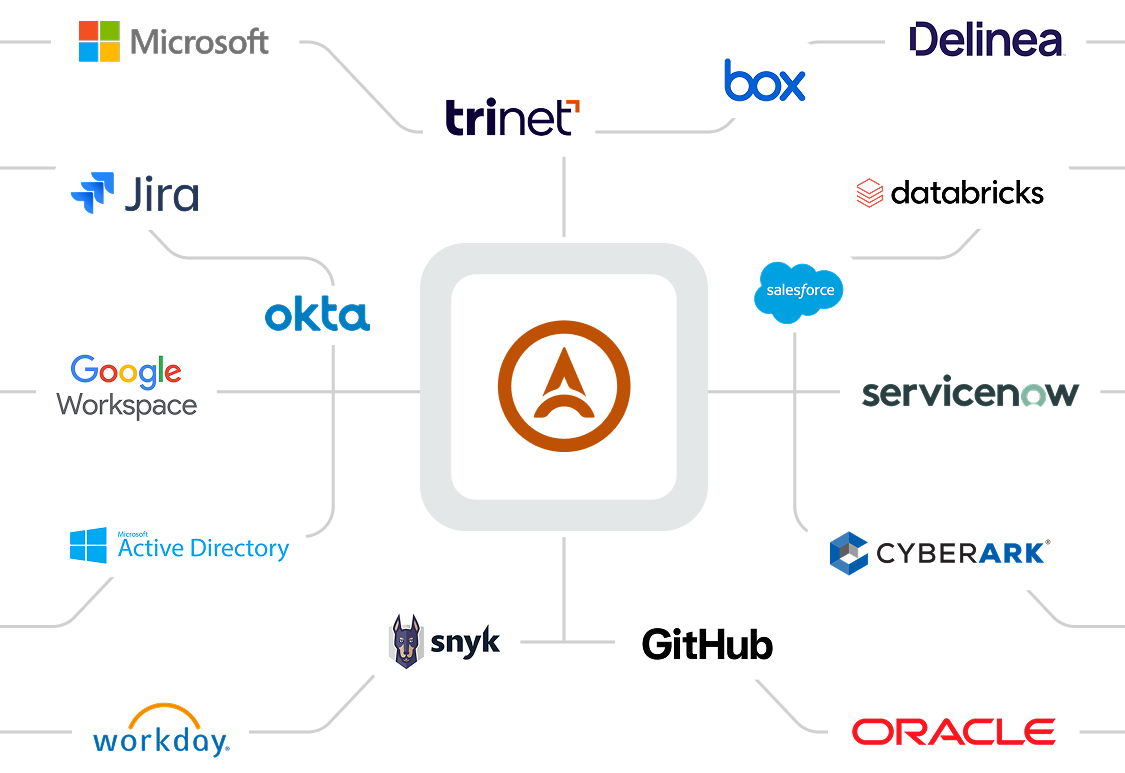
Mesh reads from the stack you have: identity providers, HR systems, cloud platforms, ticketing, PAM, and secrets managers. For AI agents, it builds on the EDR you already run, including CrowdStrike, Palo Alto Cortex XDR, and Microsoft Defender, and on Microsoft Entra Agent ID. No rip-and-replace, and nothing new to install on employee laptops.


Anthropic's Claude Mythos announcement marks a turning point in AI-driven cyber threats. Here's what it means for identity security and why phishing-resistant authentication matters more than ever.


New research from Axiad finds the real bottleneck in enterprise identity security isn't detection - it's decision. CEO David Canellos breaks down what the data reveals about why most organizations can't quantify their exposure or prioritize what to fix first.

Axiad commissioned a survey of 312 senior security and IT leaders at U.S. enterprises and uncovered a consistent gap between perceived identity risk visibility and the ability to act on it when it matters most.


An AI agent is an identity that acts for someone. It holds credentials, calls tools and data, and makes decisions without a person approving each step. Agentic identity security ties each agent to the person it acts for and an owner, records what it does, and decides what it may do.
Through the EDR you already run, including CrowdStrike, Palo Alto Cortex XDR, and Microsoft Defender, through Microsoft Entra Agent ID, and through the agents connected to the gateway.
No. Keep your cloud AI platform for the agents you build there. Mesh covers the agents beyond any single platform, on employee laptops and in other tools, and shows what they actually do.
What it did. Mesh audits each request an agent makes: what it called, where it went, whether it succeeded, and how long it took.
Yes, for agents connected through the gateway. Each call is checked against the person, the agent, and live risk, and denied unless policy allows it. Agents Mesh finds but that aren't connected are routed to an owner to approve or remove.
No. Most teams start with the audit and add policy later.
No. Keep those for the agents you build there. Mesh covers agents beyond any one platform and shows what they do.
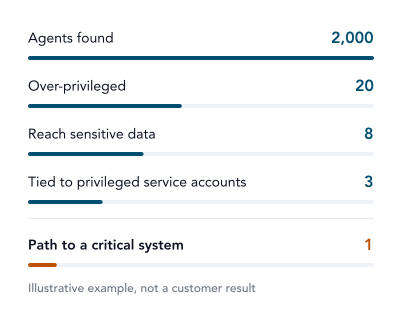
Mesh ranks each agent alongside your human and non-human identities by what it can reach and how exposed it is, so the agent with a path to a critical system rises to the top.


FedRAMP Moderate Authorized (Conductor). Frost and Sullivan Customer Value Leader. Gartner Market Guide Recognized. ISO/IEC 27001. SOC 2 Type II.
Copyright Axiad 2026. All rights reserved.