

Gartner's three-wave roadmap for the postquantum cryptography migration, available complimentary from Axiad. Covers which quantum-resistant algorithms are ready now, why key exchange is an immediate risk, and the infrastructure upgrades most migration plans miss.


Cybersecurity leaders must lead deployment of postquantum cryptography in three waves, starting now to address the quantum computing threat in time. After creating a cryptographic inventory, they must address bulk encryption and key exchange, PKI, and digital signature algorithms.
Quantum computers running Shor’s algorithm will defeat the protections provided by all classic public-key algorithms. Estimates vary as to when such a computer will be available, with the most optimistic estimates being 2029, and some of the less optimistic being 2035. Regardless of the exact date, the threat to current cryptography is real; postquantum cryptography will be required regardless of the actual threat of quantum computers.
Fortunately, there are options currently approved for use that allow for organizations to move forward with their migration. However, although these algorithms are approved, they do come with deployment challenges. This in itself is a strong reason to begin planning and testing these algorithms today.
Cybersecurity leaders must therefore lead deployment of postquantum cryptography in three waves:
Quantum computers running Shor’s algorithm are forecast to defeat the protections provided by all classic public-key algorithms, including RSA and ECC, by as early as 2029. These algorithms underpin all secured communications across network channels, whether public or private, as well as many digital signature implementations. Failure to transition to postquantum cryptography will effectively compromise the confidentiality, integrity, authenticity, and nonrepudiation from both existing and future communications, as well as the integrity, authenticity, and nonrepudiation from digital signatures.
Estimates vary of when a quantum computer capable of breaking cryptography will be available. The most optimistic estimates are 2029, and some of the less optimistic are 2035. Regardless of the exact date, the threat to current cryptography is real, and the time to act is now.
As there is a difference between a threat and the actual risk to organizations, some have questioned how they should proceed with mitigating the threat of quantum computers. Postquantum cryptography will be required regardless of the actual threat of quantum computers. For instance, NIST in the United States has dictated that all classical algorithms must be replaced no later than 2035.
Fortunately, there are options currently approved for use that allow organizations to move forward with their migration; namely, ML-KEM (FIPS-203), ML-DSA (FIPS-204), and SLH-DSA (FIPS-205). Yet, while these algorithms are approved, they do come with issues that need to be considered. This in itself is a strong reason to begin planning and testing these algorithms today.
Public-key algorithms comprise multiple functional areas of cryptography, including encryption, key establishment, and digital signatures. Each of these functional areas needs to be addressed to fully mitigate the threat of quantum computers to cryptography.
Postquantum encryption and key establishment methods are well-supported and are reasonably proven options that can be deployed today. Updated key establishment algorithms are mandatory to remediate the threat of HNDL. These should be considered in Wave 1 of updating to PQC.
Digital certificates will need to be updated because they rely on digital signatures. In addition, organizations typically have their own internal PKI to support the deployment of internal digital certificates. While we wait for digital signatures to be field-proven, internal PKIs can be upgraded now. This would be considered Wave 2, required to support PQC-safe algorithms.
Digital signatures are not drop-in ready for most production environments, yet they are just as critical to update over the long term. These are Wave 3 of updating to PQC-safe algorithms.
Foundational to starting the PQC waves is developing an inventory of all existing cryptographic assets, including algorithms, keys, cipher suites, certificates, and protocols. Review Gartner insights recorded in “Choose the Right Tools for Your Cryptographic Discovery Process” for direction on developing this inventory.
Developing a cryptographic inventory is the key prerequisite for adopting postquantum cryptography.
The algorithms that support encryption and key exchange must be updated now.
AES-256 must be the default configuration for encryption. Your cryptographic inventory will likely show the vast majority of your AES deployments set to use 256 bits. You will also likely find instances of AES-128. Organizations with older systems will likely find some instances of 3DES in use.
The strength of AES-256 is impacted by an attack from Grover’s algorithm running on a cryptographically relevant quantum computer (CRQC), but AES-256 is still considered strong protection. AES-128 is weakened to the level of 64 bit protection, but current estimates are that it would take over 400 years to determine the key. 3DES is already breakable without the need for a quantum computer, as it is susceptible to the Sweet32 attack.
Ensure all encryption is set to use AES. AES-128 is deemed sufficient for short-term needs, but is less future-proof. Prioritize the utilization of AES-256 over AES-128. In time, migrate all systems to at least AES-256.
ML-KEM-768, or FrodoKEM-976, should be utilized for key exchange effective immediately. This is a large change for most organizations as the long-term standard for key exchange has been Elliptic-Curve Diffie-Hellman ephemeral. Shor’s algorithm running on a CRQC will easily break all versions of Elliptic-Curve Diffie-Hellman, or RSA algorithms.
Key encapsulation mechanisms (KEMs) are used in all secure network communications. Examples that utilize KEMs include, but are not limited to, TLS, SSH, IPsec, WireGuard, Signal, PGP, ZRTP, FIDO2, SAML, blockchain, and iMessage.
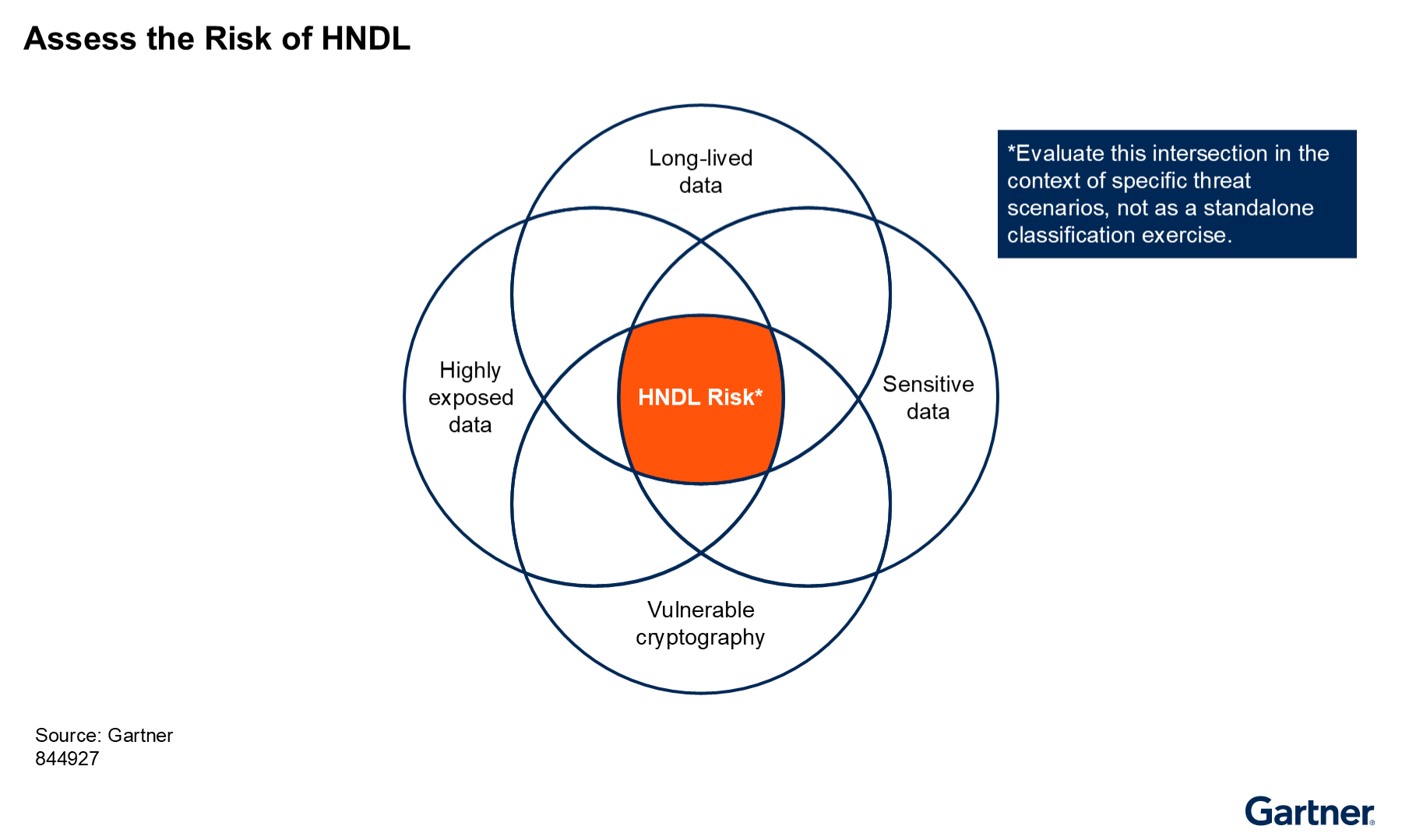
Due to the HNDL threat, the risk to organizations from traditional KEMs is already present. The primary purpose of the KEM is to establish the shared keys that will be used for confidentiality and integrity control. For instance, in a TLS session, the KEM will establish which key will be used with AES to encrypt the data transferred in the session. The KEM ensures both parties use the same key. If the key established by the KEM can be determined, all of the data in the AES session can be read.
This is an immediate risk for organizations as data considered interesting to an attacker could be captured and stored in an encrypted format. Once a CRQC is available, Shor’s algorithm could be utilized to determine the key generated. Any data that is interesting could then be read.
Update to a quantum-resistant algorithm for key exchange now. ML-KEM and FrodoKEM should be considered based on your requirements. As the list of systems and applications that rely on KEMs is long, the update process will be time- and resource-consuming. Using the information from the cryptographic inventory, assess the most critical systems and deploy accordingly. Consult “Harvest Now, Decrypt Later” Attacks Aren’t Just a Postquantum Problem for insights on how to further assess risk to systems (see Figure 1).
Not all systems will be upgradable due to hardware, software, or compatibility constraints. These will need to be addressed on a risk-quantified basis.
The second wave in updating to PQC algorithms is migrating the public-key infrastructure to issue digital certificates that utilize PQC digital signatures.
The quantum computing threat will necessitate PKI to support the utilization of quantum-resistant algorithms to ensure the continued security of digital certificates and secure communications.
Every component in the PKI chain must be updated to understand the new math behind the new PQC algorithms. PKI platforms must be upgraded, likely requiring versions released no earlier than 2025. Previous versions of the platforms likely will not understand how to create or sign a PQC certificate. Servers and clients must use updated cryptographic libraries to perform the handshakes; otherwise, the operating system will see the certificate as corrupt data.
Full support for PQC is most commonly seen in vendors’ late 2025 or early 2026 releases of their PKI software. Upgrade your software once you have confirmed your vendor is shipping software that offers full support for PQC. Supported versions for representative vendors are in the Evidence section. Update cryptographic libraries such as OpenSSL 3.5+ and update to the most up-to-date version of the operating system, such as Windows Server 2025+ or Windows 11 v24H2/25H2. Also, it should be noted that publicly issued certificates now expire every 200 days. It is strongly recommended to deploy ACME or SCEP to automate public certificate refreshes. Organizations should at least consider automation for internally deployed certificates as well.
The private keys for the root and issuing CAs may be stored in an HSM.
PQC algorithms introduce two challenges for these devices. First, PQC keys are significantly larger than RSA or ECC keys. HSMs must have the memory and storage capacity to handle them. Second, PQC signatures are computationally more intensive. Older HSMs may have physical chips hardwired for RSA and ECC math. These chips cannot be reprogrammed for lattice-based math. If the general-purpose CPU inside the HSM is too weak to handle PQC in software, a hardware refresh is required.
Assess the ability of HSMs to support the new algorithms. A firmware update is highly likely, but it is very likely you will need to replace your HSM with a new model.
The next round of algorithms to be addressed is digital signature algorithms. These are just as critical as the algorithms in Wave 1, but the feasibility of the algorithms limits their immediate deployment.
NIST has approved ML-DSA and SLH-DSA as digital signature algorithms that are resistant to Shor’s algorithm running on a CRQC. Yet, no digital signature algorithms are drop-in replacements for current classical algorithms in TLS due to performance issues from enlarged key and signature sizes. Realizing the issues with current options, NIST has ongoing research into additional digital signature schemes.
Digital signatures are used for authentication to prove that senders are who they say they are, and for integrity to prove that the data hasn’t been changed. Digital signatures are used in protocols such as, but not limited to, TLS, SSH, IPsec, QUIC, S/MIME, OpenPGP, DKIM, DNSSEC, and SAML. A key market where digital signatures are foundational is eSignatures, aligning with global standards like the U.S. ESIGN Act and the EU’s eIDAS. All documents signed using classical algorithms could be forged or invalidated by running Shor’s algorithm on a CRQC. This includes all historical or archived documents, including financial or legal documents. The only slight wrinkle with this are long-lived signing use cases that are hard to change where you might need to use PQC now to future-proof (e.g., in manufacturing, where “trust now, forge later” could be a concern). There are also signatures related to legal liability concerns where you might want to add a PQC signature sooner rather than later.
ML-DSA is put in Wave 3 as it is not ready for most production environments. NIST has several other candidates for a quantum-resistant digital signature that may prove to be more appealing from a performance and key size standpoint. It is important to watch NIST for new standards regarding digital signatures. Forward-looking organizations should deploy ML-DSA in nonproduction environments to determine what impact it will have on their systems. If ML-DSA is decided to be the best option for quantum-resistant digital signatures, the organization will have the experience to deploy it and the research needed to justify its use over the other digital signature options. Keep in mind that hardware upgrades will be required if organizations choose to move forward with ML-DSA.
There are many other hardware devices that will need to be updated in your environment. While outside the scope of this report, the following devices will likely need to be reviewed for compatibility with PQC.


FedRAMP Moderate Authorized (Conductor). Frost and Sullivan Customer Value Leader. Gartner Market Guide Recognized. ISO/IEC 27001. SOC 2 Type II.
Copyright Axiad 2026. All rights reserved.